The November Issue
24 Nov 2025
Love as a Solitude I Choose

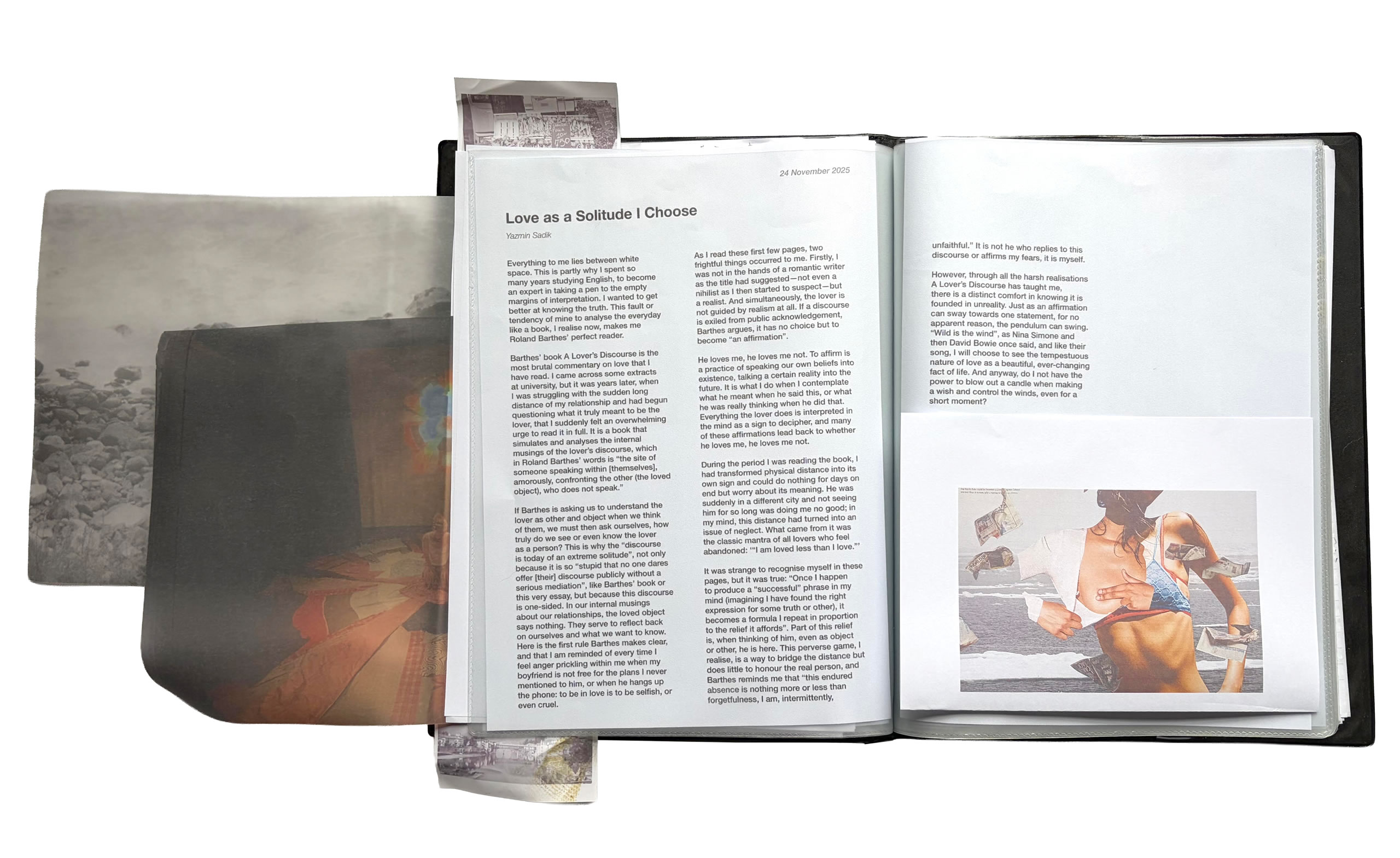
Feminist collage using women's traditional practises by Yazmin Sadik
Everything to me lies between white space. This is partly why I spent so many years studying English, to become an expert in taking a pen to the empty margins of interpretation. I wanted to get better at knowing the truth. This fault or tendency of mine to analyse the everyday like a book, I realise now, makes me Roland Barthes' perfect reader.
Barthes' book A Lover's Discourse is the most brutal commentary on love that I have read. I came across some extracts at university, but it was years later, when I was struggling with the sudden long distance of my relationship and had begun questioning what it truly meant to be the lover, that I suddenly felt an overwhelming urge to read it in full. It is a book that simulates and analyses the internal musings of the lover's discourse, which in Roland Barthes' words is "the site of someone speaking within [themselves], amorously, confronting the other (the loved object), who does not speak."
If Barthes is asking us to understand the lover as other and object when we think of them, we must then ask ourselves, how truly do we see or even know the lover as a person? This is why the "discourse is today of an extreme solitude", not only because it is so "stupid that no one dares offer [their] discourse publicly without a serious mediation", like Barthes' book or this very essay, but because this discourse is one-sided. In our internal musings about our relationships, the loved object says nothing. They serve to reflect back on ourselves and what we want to know. Here is the first rule Barthes makes clear, and that I am reminded of every time I feel anger prickling within me when my boyfriend is not free for the plans I never mentioned to him, or when he hangs up the phone: to be in love is to be selfish, or even cruel.
As I read these first few pages, two frightful things occurred to me. Firstly, I was not in the hands of a romantic writer as the title had suggested - not even a nihilist as I then started to suspect - but a realist. And simultaneously, the lover is not guided by realism at all. If a discourse is exiled from public acknowledgement, Barthes argues, it has no choice but to become "an affirmation".
He loves me, he loves me not. To affirm is a practice of speaking our own beliefs into existence, talking a certain reality into the future. It is what I do when I contemplate what he meant when he said this, or what he was really thinking when he did that. Everything the lover does is interpreted in the mind as a sign to decipher, and many of these affirmations lead back to whether he loves me, he loves me not.
During the period I was reading the book, I had transformed physical distance into its own sign and could do nothing for days on end but worry about its meaning. He was suddenly in a different city and not seeing him for so long was doing me no good; in my mind, this distance had turned into an issue of neglect. What came from it was the classic mantra of all lovers who feel abandoned: '"I am loved less than I love."'
It was strange to recognise myself in these pages, but it was true: "Once I happen to produce a 'successful' phrase in my mind (imagining I have found the right expression for some truth or other), it becomes a formula I repeat in proportion to the relief it affords". Part of this relief is, when thinking of him, even as object or other, he is here. This perverse game, I realise, is a way to bridge the distance but does little to honour the real person, and Barthes reminds me that "this endured absence is nothing more or less than forgetfulness, I am, intermittently, unfaithful." It is not he who replies to this discourse or affirms my fears, it is myself.
However, through all the harsh realisations A Lover's Discourse has taught me, there is a distinct comfort in knowing it is founded in unreality. Just as an affirmation can sway towards one statement, for no apparent reason, the pendulum can swing. "Wild is the wind", as Nina Simone and then David Bowie once said, and like their song, I will choose to see the tempestuous nature of love as a beautiful, ever-changing fact of life. And anyway, do I not have the power to blow out a candle when making a wish and control the winds, even for a short moment?